The hotel front desk clerk at the Holiday Inn Express in Mitchell, South Dakota, did not have a folio to print for us. We had booked the room on IHG points, and the system doesn’t generate a printable receipt for reward stays. She looked at us, looked at the screen, and then hand-wrote onto a piece of paper that we had stayed the night, with both our names on it. That handwritten note is now part of our domicile file.

This August, we flew from Nairobi to Chicago for a summer trip I’d been looking forward to for months. Deep dish pizza, my daughter’s first baseball game, time in Wisconsin with my parents on the land my paternal great-grandmother brought the family to from Lithuania three generations ago. And somewhere in the middle of all that, Laban and I took a one-day detour to South Dakota to visit a DMV.
Not Mount Rushmore. Not the Badlands. A DMV in Mitchell, South Dakota, that handles the kind of thing most American expats never think about until it catches them. It took us almost three years to finally do this, and the actual trip was smoother than I expected. If you’re an American living abroad who moved from California, New York, Illinois, or any other high-income-tax state, this post covers what we did, what we learned, and whether it’s worth your time.
The Problem Most American Expats Don’t Know They Have
Everyone who moves abroad knows they still have to file US federal taxes. The United States taxes its citizens on worldwide income regardless of where they live. That’s unusual, mildly annoying, and just a fact of American citizenship.
What most people don’t know is that state-level taxes are a completely separate and more complicated question.
When you move out of a US state, you don’t automatically stop being a resident of that state for tax purposes. Domicile, under California law (R&TC Section 17014), is defined as the place where you intend to make your permanent home. The California Franchise Tax Board (FTB) takes an expansive view of this. If you moved from California to Kenya, or Germany, or anywhere else, without formally establishing domicile in another state, California can argue your domicile never changed. And California taxes worldwide income.
FTB Publication 1031 (2025 edition) outlines the specific factors California uses to determine domicile. The list includes the location of your driver’s license, where your vehicles are registered, where you keep your most important personal belongings, where your professional licenses are held, and where you vote. Your driver’s license is one of the most visible and easily documented factors on that list.
Here’s our situation. In 2023, we moved back to Kenya after eight years in the US for my PhD. For the first year or so, we had the postal service forward our mail to my parents’. Practical, convenient, and not a long-term solution. About a year ago, we set up a proper mail forwarding address in South Dakota through a service built specifically for Americans living abroad and frequently traveling. The final step was the one we did in August: get to a South Dakota DMV, get South Dakota driver’s licenses, close the loop.
As long as our driver’s licenses said California, there was a live argument that California could claim our consulting and business income. Getting South Dakota licenses removes that argument.
Why South Dakota Specifically
South Dakota has no state income tax. Zero. It’s one of nine states in the US that doesn’t tax individual income.
It also has a residency program specifically designed for Americans without a permanent US address: people living abroad, full-time travelers, people between addresses. The program is supported by private mail forwarding services, most of which are based in Spearfish in western South Dakota. SDRC (South Dakota Residency Center) and America’s Mailbox are the two most established ones. The state’s official relocation arm, ChooseSD, promotes this as a feature.
The requirements to establish South Dakota residency are three:
- A South Dakota mailing address, obtained through a mail forwarding service
- One overnight stay in South Dakota
- A visit to any South Dakota DMV for a driver’s license
That’s it. One night. One DMV visit. No apartment lease, no utility bills, no proof of extended time in the state. The program was built for people whose permanent life is somewhere else.
For the mailing address step, the two established services in Spearfish are SDRC (South Dakota Residency Center) and America’s Mailbox. Both are built specifically for Americans living abroad and full-time travelers, and both handle the mail scanning and forwarding that makes a remote US address work. We set ours up over a year ago and it’s been reliable. There are also virtual mailbox platforms like Anytime Mailbox and Traveling Mailbox that aren’t tied to one physical location, if you want to compare options before committing.
You Don’t Have to Go to Spearfish
Almost everything written about South Dakota domicile assumes you have to make your way to Spearfish, where the mail forwarding services are based. People fly into Rapid City, rent a car, drive 45 minutes to Spearfish, stay at the KOA, go to the Spearfish DMV, done.
But that’s not the rule. The rule is that you need one overnight stay in South Dakota and a visit to any South Dakota DMV. The DMV doesn’t have to be in the same city as your mailbox service. Your mailbox address is in Spearfish. You can get your license in Mitchell.
We proved this on our trip. We didn’t drive eight hours from Wisconsin to Mitchell. We drove four and a half hours from Rhinelander to Minneapolis, flew 30 minutes to Sioux Falls, rented a car, and drove one hour to Mitchell. The Mitchell DMV isn’t near Spearfish. It doesn’t matter. Any South Dakota DMV works.
And once I started looking at reviews for the Mitchell DMV, the decision was easy: people drive from Sioux Falls to go to Mitchell because the Mitchell DMV has significantly better reviews. Shorter waits, smoother process, friendlier staff. We booked our appointment online in advance at dps.sd.gov and went first thing in the morning.
How We Got to Mitchell: Wisconsin to Minneapolis to Sioux Falls
Here’s what the day actually looked like, because the logistics are the part that feels overwhelming from Nairobi but turned out to be manageable from Wisconsin.
We left Rhinelander by car in the morning and drove about four and a half hours to Minneapolis. We had extra time before our flight, so we stopped at Minnehaha Falls, which is a lovely little park right in the city and a nice way to see a slice of Minneapolis without committing to a full day there.

After that, we headed to the airport and spent a few hours in the lounge using our Priority Pass access (honestly one of the better perks of the travel cards we carry, and a good way to wait out a flight without spending on airport food).

The flight from Minneapolis to Sioux Falls is about 30 minutes. We traveled with carry-on only, which meant no bag pickup on the other end. We landed, walked to the rental car counter, and were on the road within minutes. Sioux Falls to Mitchell is about one hour by car, straight west on I-90.

It’s flat, open farmland the whole way, which is its own kind of beautiful if you’re used to Nairobi traffic.

We stayed at the Holiday Inn Express in Mitchell, booked on IHG points (we had about 36,000 points available, which covered the night). The hotel is in a small compound with a Mexican restaurant right across the parking lot, and I’ve got to say, it was some of the best Mexican food we’ve had in a long time. Huge margaritas, excellent food, and the convenience of walking across a parking lot after a long travel day. If you stay at the Holiday Inn Express, eat there.

The Mitchell DMV: 30 Minutes, In and Out
Our appointment was at 10:30. We got there around 9:15 because we were nervous about missing it, and the DMV is in a small area that didn’t look like a big DMV building from the outside. That made us worry at first, but it turned out to be a good thing. There was no crowd.
I had checked in online the night before, which sent me a text message. When we arrived, I replied to the text to say I was there, and they called us over. We filled out the driver’s license application there at the DMV (they provide the forms), and we also filled out the residency affidavit there (they provide that too). You don’t need to bring these forms pre-filled, but you do need to bring the documents that go with them.
Here’s the part I want to flag: it’s supposed to be one appointment per person. I had only made one appointment to cover both of us, which isn’t how it works. The woman at the counter was kind about it and just added my husband as a walk-in, so you can do walk-ins, but I’d make separate appointments for each person if you can. It’s less stressful.
The two women running the counter that morning were, hands down, the reason this worked. They handled the queue impeccably (there wasn’t a queue, honestly, because they were so fast and so kind and so effective). They made us laugh. I’ve been to a lot of DMVs in my life, and this was the best experience I’ve ever had. It’s worth driving the extra hour to Mitchell just for this.
One small scare: my husband’s eyes aren’t perfect, and he had a little trouble with the vision test. That was a frightening moment because we’d traveled so far just for this DMV, and a failed vision test would have meant no license. The woman was understanding, his results weren’t bad enough to fail, and she approved it. But if you or your partner have any vision concerns, get your eyes checked before you make the trip. It would be a rough thing to travel all that way and get stopped at the vision test.
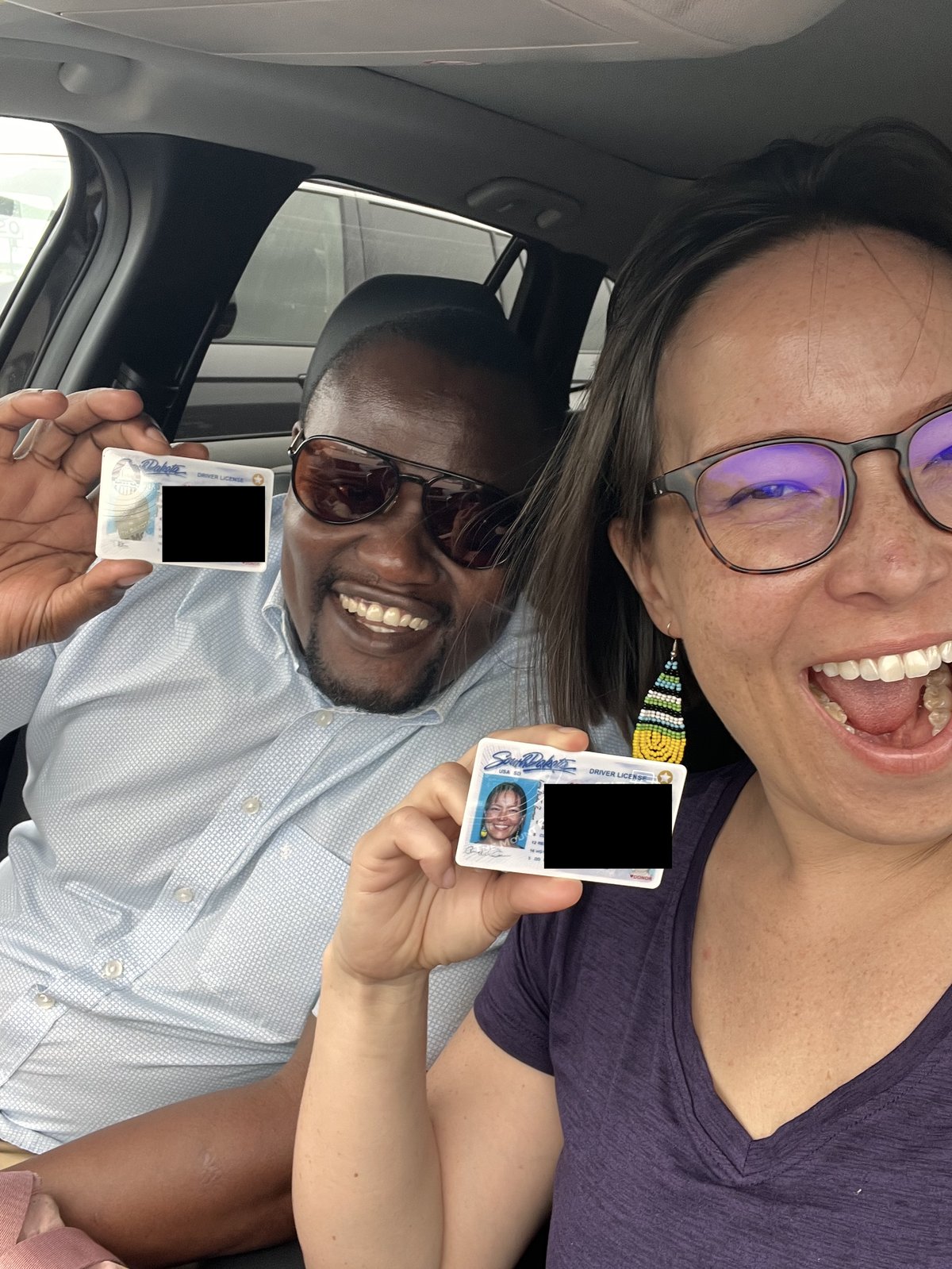
We were in and out within 30 minutes. They printed our driver’s licenses right there on the spot. No mailing, no waiting for something to arrive at our SD address. We walked out with physical licenses in hand, and we were done by 10:00.
What to Bring (and What Tripped Us Up)
Here’s what you need at the DMV:
- US passport (original, not a copy)
- Proof of Social Security number (your SSA card, a W-2, or a 1099)
- Your South Dakota mail service agreement showing your SD address
- Your hotel receipt from the overnight stay in South Dakota
- A notarized residency affidavit (which you can do at the DMV)
- Your prior state driver’s license to surrender (if you still have it)
Both adults in a couple need to go in person. If you no longer have your previous state driver’s license, that’s fine. South Dakota can cancel your old license through the interstate Driver License Compact without you needing to produce the physical card. I’d lost mine years ago and it wasn’t a problem.
The one thing that tripped us up was the hotel receipt. We booked the Holiday Inn Express on IHG points, and when we asked for a folio at checkout, the system couldn’t print one because reward stays don’t generate a standard folio. This is a real problem for domicile documentation, because the hotel receipt is one of the things you need to show you spent the night in South Dakota.
The front desk clerk figured it out. She hand-wrote on a piece of paper that we’d stayed the night, with both our names on it, and that worked. But if you’re booking on points, ask about this at check-in, not at checkout. And make sure both names are on the reservation. If only one name is on the booking, only one of you has proof of the overnight stay.
What South Dakota Domicile Doesn’t Fix
To be clear: establishing South Dakota domicile doesn’t make you exempt from taxes in every state.
If you own property in California that generates rental income, you’ll still file California taxes on that rental income every year. California taxes California-source income regardless of where you’re domiciled. A South Dakota address doesn’t change your obligation on income earned from California sources.
What South Dakota domicile does is protect your other income: consulting fees, business income, investment returns, anything that isn’t California-source. California can only tax a non-resident on income from California sources. Once you’re a South Dakota resident rather than a California resident, your worldwide income no longer belongs to California. That’s the distinction that matters.
Is This Relevant to You?
This post is specifically useful if you:
- Are a US citizen living abroad who moved from a high-income-tax state: California, New York, Illinois, Oregon, or Minnesota are the most common ones
- Left your home state without formally establishing domicile somewhere else
- Are currently using a family member’s address in a high-tax state as your US mailing address
- Still have your old state driver’s license on record
If you originally lived in Texas, Florida, or Nevada before moving abroad, you’re likely fine. Those states have no income tax, and your existing domicile already protects you.
If you’re in a gray area, meaning you left a high-tax state but never sorted out where you’re officially domiciled now, that’s exactly the situation this addresses. The California FTB has an active program for reviewing former residents, and J. Lunt, OTA Case No. 230112468 (2025) shows how California pursues domicile questions when someone leaves the state without clearly establishing residency elsewhere.
The Flight Back
After the DMV, we drove the one hour back to Sioux Falls, returned our rental car, and waited at the airport. We had lunch there and then flew the 30 minutes back to Minneapolis.

We drove back from Minneapolis straight through, and we were back to Rhinelander, Wisconsin by 7:30 PM in time for dinner with our kids and my parents.
Frequently Asked Questions
Do I still need to file state taxes if I live abroad?
It depends on your last US state of residence before moving abroad. If you lived in a state with income tax (like California or New York) and haven’t formally changed your domicile, that state may still consider you a resident and may still tax your worldwide income. Living abroad doesn’t automatically sever state residency. You need to take a deliberate step to establish domicile somewhere else.
What state should American expats claim as their domicile?
South Dakota is the most popular choice for Americans living abroad because of three factors: no state income tax, the lowest physical presence requirement of any no-income-tax state (one overnight stay), and an established support structure through private mail forwarding services in Spearfish. Florida and Texas are also valid options but require more physical presence to document.
How do you establish South Dakota residency as an expat?
Three steps. First, set up a South Dakota mailing address through a mail forwarding service (SDRC and America’s Mailbox are both based in Spearfish and are the two most established options; virtual mailbox platforms like Anytime Mailbox or Traveling Mailbox work as alternatives if you want a provider that isn’t tied to one location). Second, spend one night in South Dakota. Third, visit any South Dakota DMV with your passport, SSN documentation, and mail service agreement. You don’t have to go to the same city as your mail forwarding service. Both people in a couple must go in person. Book your appointment online in advance at dps.sd.gov, and make a separate appointment for each person.
How long does the Mitchell DMV take?
Our entire visit took about 30 minutes, and that included filling out the application and affidavit at the DMV. We had a 10:30 appointment, arrived around 9:15, and were out by 10:00 with printed licenses in hand. The Mitchell DMV is staffed by people who are fast, kind, and effective. It’s worth driving the extra hour from Sioux Falls to use this DMV instead of others.
What happens if you book your South Dakota hotel on points?
Reward stays typically don’t generate a printable folio, which is a problem because the hotel receipt is your proof of the overnight stay. Ask at check-in, not checkout. The Holiday Inn Express in Mitchell hand-wrote a receipt for us with both our names on it, which worked. Make sure both names are on the reservation when you book.
Can California tax me if I live in Kenya?
California can tax your worldwide income if it considers you a California domiciliary. If you moved from California without formally establishing domicile in another state, and still hold a California driver’s license or have other California ties, the FTB may argue you’re still a California resident. FTB Publication 1031 (2025 edition) outlines the specific domicile factors California examines.
What documents do I need for South Dakota residency at the DMV?
US passport, proof of Social Security number, your South Dakota mail service agreement, a receipt from an overnight stay in South Dakota, and a notarized residency affidavit (which you can do at the DMV). If you still have your prior state driver’s license, bring it to surrender. A hotel receipt works for the overnight stay proof, but if you book on points, ask about the folio issue at check-in.
Which South Dakota DMV should I use?
Any of them. You don’t have to go to the DMV nearest your mailbox address. We used Mitchell and it was the best DMV experience I’ve ever had. People drive from Sioux Falls to Mitchell because the reviews are better. Spearfish is the traditional choice if you’re already in western South Dakota for the mail forwarding services, but if you’re coming from the midwest or flying into Sioux Falls, Mitchell makes more sense. Book an appointment online before you go, one per person.
The Verdict
This isn’t a tax loophole. It’s a legal process designed for people who actually don’t live in the United States and need a valid US domicile for driver’s license, banking, and tax purposes. South Dakota built this program deliberately. The state gets residents on paper; the residents get legal clarity and a no-income-tax domicile.
For us, the whole detour was one day. Drive from Wisconsin to Minneapolis, fly to Sioux Falls, drive to Mitchell, sleep one night, DMV in the morning, drive back to Sioux Falls, fly back to Minneapolis, drive back to Rhinelander. We were back by 7:30 PM in time for dinner with our kids and my parents. The DMV itself took 30 minutes.
Looking at it from Nairobi, the logistics of getting to Mitchell, South Dakota feel overwhelming. Looking at it from Wisconsin, where we were already going to be for three weeks, it was a one-day trip that we slotted into the middle of a family vacation. If you’re already planning to be in the US for any reason, and you moved from a high-tax state, this is one of the highest-leverage things you can do with a free day.
Every American expat’s situation is different. What applies to us may not apply to you in exactly the same way, especially if your income structure is different or if you have state-specific obligations beyond a rental property. For your specific filing history and state obligations, talk to a US tax professional who specializes in expats.
We did it. We’ve got the licenses, the handwritten hotel receipt is in the file, and I’m still slightly in disbelief that the hardest part of a three-year project turned out to be a 30-minute visit to the nicest DMV staff I’ve ever met.
This post reflects our own experience and the information available as of August 2026. It isn’t legal or tax advice. Consult a qualified US tax professional for your specific situation.
Leave a Reply